











Sportsmanship in Dance - The Good, The Bad, The Ugly

As the new feis season gets underway, dancers will be remembered for more than their results. The way they win, lose and treat others can leave an impression long after the awards have been packed away.
Every feis has them: the good sports, the disappointed dancers who need a moment to regain their composure, and those whose behavior becomes more memorable than their dancing.
Competition brings out strong emotions. Dancers spend countless hours preparing their steps, building stamina, perfecting technique and working toward goals that may have taken years to reach. Parents invest time, money and energy, while teachers pour an enormous amount of themselves into every dancer who takes the stage.
With so much invested, disappointment is understandable but how you handle that disappointment is something every dancer needs to think about.
MORE THAN A HANDSHAKE
Good sportsmanship is not limited to smiling when you win or congratulating the dancer beside you. It is reflected in dozens of small decisions made throughout the day.
It means making room for another dancer backstage, treating stage personnel courteously and applauding competitors from other schools. It means respecting the musicians, adjudicators, volunteers and feis organizers who make the event possible. It also means avoiding unkind comments, whether they are made in the ballroom, whispered in the hallway or posted online after the competition.
A dancer does not have to be happy with a result. However, there is a difference between feeling disappointed and behaving disrespectfully.
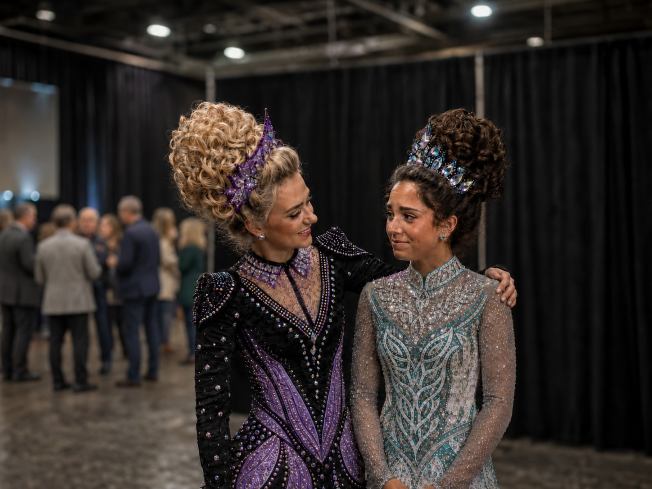
Crying after a difficult result does not make someone a bad sport. Neither does needing a few quiet minutes away from the crowd. The important question is what happens next. Does the dancer regain composure, congratulate others and begin thinking about what can be learned? Or does the disappointment turn into accusations, insults or an attempt to diminish someone else’s achievement?
Your reaction to a result can be remembered by other dancers and audience members for years.
IRISH DANCE RESULTS ARE NOT SIMPLE
Irish Dance is judged by trained adjudicators. An adjudicator evaluates qualities such as timing, rhythm, technique, carriage and execution, and different judges may respond differently to the same performance.
At championship level, adjudicators assess a dancer across three rounds. Their individual placings are converted into Irish points and combined to determine the final result. That is why a dancer can place very highly with one adjudicator and considerably lower with another, and why looking at one raw score rarely tells the entire story.
It is natural to wonder why a result did not match expectations. It is not appropriate to confront an adjudicator, attack another dancer or school, or suggest that a winner did not deserve the result.
A dancer’s best first step is to speak privately with their teacher. The teacher can help interpret the marks or comments, place the result in context and identify areas that may need attention. Was timing secure? Did technique weaken as the dance progressed? Was the performance as strong onstage as it had been in practice? Sometimes there will be a useful lesson. At other times, the dancer may simply have encountered a panel whose preferences differed.
ADULTS SET THE TEMPERATURE
Young dancers pay close attention to how the adults around them react. A parent who immediately criticizes the judging, another dancer or a rival school may unintentionally teach a child that every disappointing result requires someone to blame.
Teachers and parents can instead acknowledge the emotion without feeding the anger:
“I know you are disappointed. You worked very hard. Let’s congratulate the dancers who placed, and then we can talk with your teacher about what comes next.”
That response does not dismiss the dancer’s feelings. It shows them how to experience disappointment without allowing it to control their behavior.
Winning also requires character and balance. Dancers should feel free to celebrate an achievement they have worked hard to earn. Jumping into a teacher’s arms, hugging family members or sharing happy tears are natural reactions to an exciting result. But an extended or overly excited celebration can be painful for the dancer standing nearby who has just experienced a major disappointment.
CAN A RESULT BE CHALLENGED?
Competition rules differ among Irish Dance organizations, so dancers and parents should never assume that an unexpected placing can be appealed.
Many feiseanna state that the adjudicator’s decision is final. Some organizations provide a formal process for objections, but this may apply only when there is a possible rule violation, eligibility issue, tabulation error or other procedural concern. It does not necessarily provide a way to challenge an adjudicator’s personal assessment of a performance.
Any genuine concern should be taken to the dancer’s teacher, who can review the applicable rules and determine whether further action is warranted. Adjudicators should never be approached directly by dancers or parents.
If a formal concern is raised, it should be handled discreetly through the correct channels and not debated in the hallway or tried online.
THE LASTING IMPACT
Good sportsmanship does not mean pretending that every result feels fair. It means recognizing that no medal, sash or trophy gives anyone permission to be cruel.
Learning to compete with integrity is part of a dancer's development. The ability to accept feedback, recover from disappointment, respect an opponent and return to work will serve a dancer long after their final feis.
At the next competition, ask yourself one question:
How do I want my competitors and the audience to remember me?
Keep Irish Dance at Your Fingertips
For more expert advice, inspiring dancer stories and competition coverage subscribe to Irish Dancing Magazine. Choose print or digital delivery and enjoy every issue wherever your dancing takes you. We Educate. We Inspire. We Motivate. WE ARE IDM.